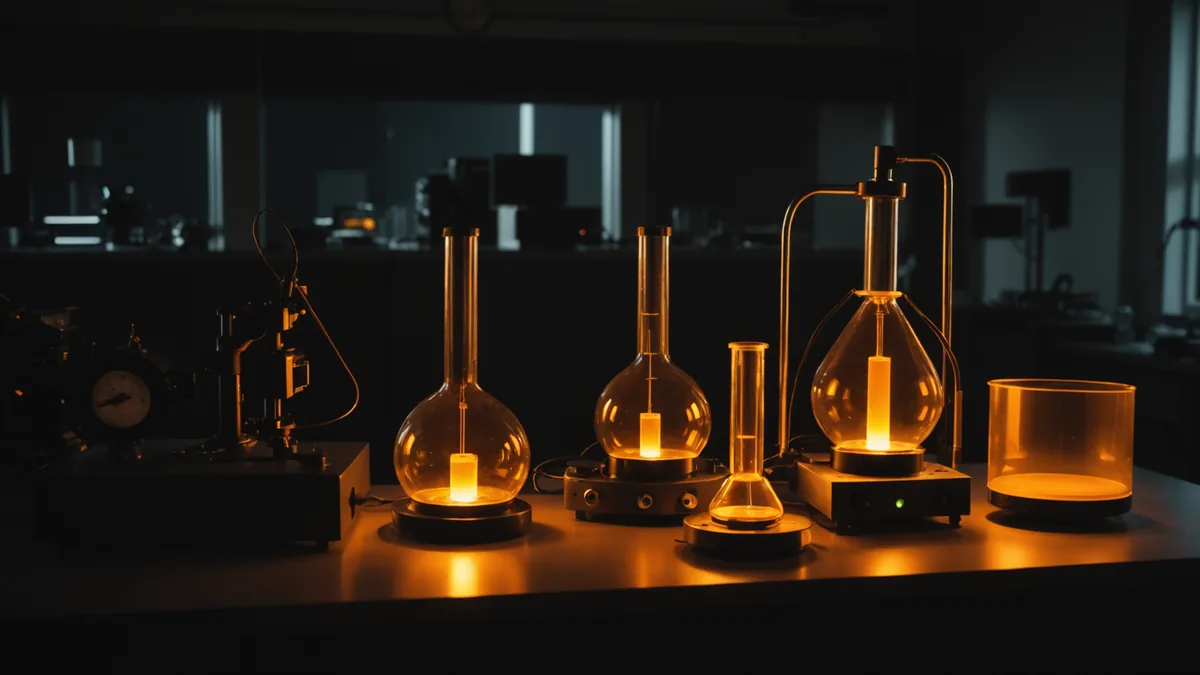
Research labs accumulate equipment: an SPR instrument, high-throughput plate reader, liquid handler, and HPLC system. Each capital asset carries a major sunk cost. The usual case for buying these instruments is a lower per-run cost than sending samples to a CRO. That holds per assay, but overlooks utilization. Most instruments run below capacity, and a nearly idle instrument has a very different cost structure from one operating at 80 percent utilization.
This note examines the economics of idle time and what it means for upstream choices that decide which samples enter the instrument queue.
The fixed costs of lab equipment
For an SPR instrument costing $250,000, the usual per-assay calculation spreads amortized capital cost across annual assays. At 200 assays per year, capital contributes about $180 per assay over a seven-year useful life. Add $25,000 per year in service contracts, $80 to $150 per assay for consumables, and operator time, and a well-utilized instrument costs roughly $300 to $500 per SPR assay.
"Well-utilized" carries the calculation. An SPR instrument running 200 assays per year operates at roughly 15 to 20 percent of technical capacity, since most instruments handle 8 to 12 samples per day with automated loading. Academic and early-stage discovery labs often run only 30 to 50 assays per year. At 30 assays per year, capital cost exceeds $1,100 per assay before consumables and labor. Service contracts and depreciation accrue every day, whether the instrument runs one sample or fifty.
This is the first hidden cost: low-utilization instruments cost far more per assay than their sticker price suggests. Early discovery utilization stays low because compound synthesis limits the sample queue.
How queue depth drives idle time
A drug discovery lab's instrument queue depends on synthesis. Ten new compounds per month means ten assays per month. A failed route or absent chemist slows synthesis and leaves instruments idle. A promising scaffold can accelerate synthesis, clogging the queue and leaving samples waiting weeks.
Synthesis and assay queues are tightly linked, and usually serial: synthesize, characterize, then assay. Computation can come first. Computational screening changes which compounds get synthesized, removing obvious non-binders and ADMET failures before a chemist reaches for a flask. Fewer compounds then enter each queue, while the probability that each is worth assaying stays the same or improves.
Fewer synthesized compounds also mean fewer assays, which may seem to worsen utilization. The useful comparison is not more assays versus fewer assays on the same compounds. It is more assays on the same compound count versus fewer assays on fewer, better compounds. Cost per useful data point falls when pre-filtering removes compounds likely to yield uninformative negative results.
The indirect cost of failed queue compounds
A compound that fails the binding assay costs more than its synthesis. It uses buffer, antibody, protein, and instrument time, and in a crowded queue delays other samples. It also creates a negative data point to process, document, and explain at internal review, consuming meeting time and scientific bandwidth.
At initial screening, early-discovery compound failure is typically 60 to 80 percent. Of every ten compounds reaching the assay bench, six to eight show no meaningful activity or fail a selectivity or ADMET filter that computation could have applied. That is normal when exploring chemical space rather than running confirmatory assays, but it means much of the queue produces no actionable positive signal.
A computational pre-filter that cuts failure from 70 percent to 40 or 50 percent need not be perfectly accurate. It only needs to identify non-binders better than random. For a prepared target with a validated docking protocol, that threshold is readily met for rigid, drug-like scaffolds binding well-defined orthosteric sites. The lower failure rate is real, and the queue becomes shorter.
When idle equipment is the right answer
This is not a case for divesting instruments or treating all idle time as misallocation. An SPR instrument idle between compound synthesis campaigns still has value as an available resource. The question is whether a shorter, better-curated queue could reduce the idle interval between campaigns.
Some synthesis workflows gain little from computational pre-filtering. Fragment-based drug discovery screens very small, low-complexity compounds that docking serves poorly because binding poses are less constrained and scoring functions perform worse in fragment space. Covalent warhead compounds need specialized treatment. Phenotypic screening, where the target is unknown in advance, gains nothing from target-based docking. These are genuine limitations, not minor caveats.
The point concerns the standard small-molecule, structure-based workflow aimed at a protein with a known binding site. There, synthesize-then-screen burdens both synthesis and assay queues. A computation-first pre-filter at the start of each campaign reduces that burden with a modest setup-time investment.
Make the calculation explicit for your lab
For your lab, gather the number of compounds synthesized per discovery cycle, current first-assay failure rate, loaded synthesis cost including chemist time, and loaded assay-run cost. Values differ across lab types and institutions, but the calculation is simple. For most teams synthesizing 30 to 60 compounds per campaign, we find computational pre-filtering breaks even after removing two to four compounds per campaign that would have failed the assay. With a 70 percent failure rate on a 40-compound set, removing four compounds is a modest threshold.